.png)
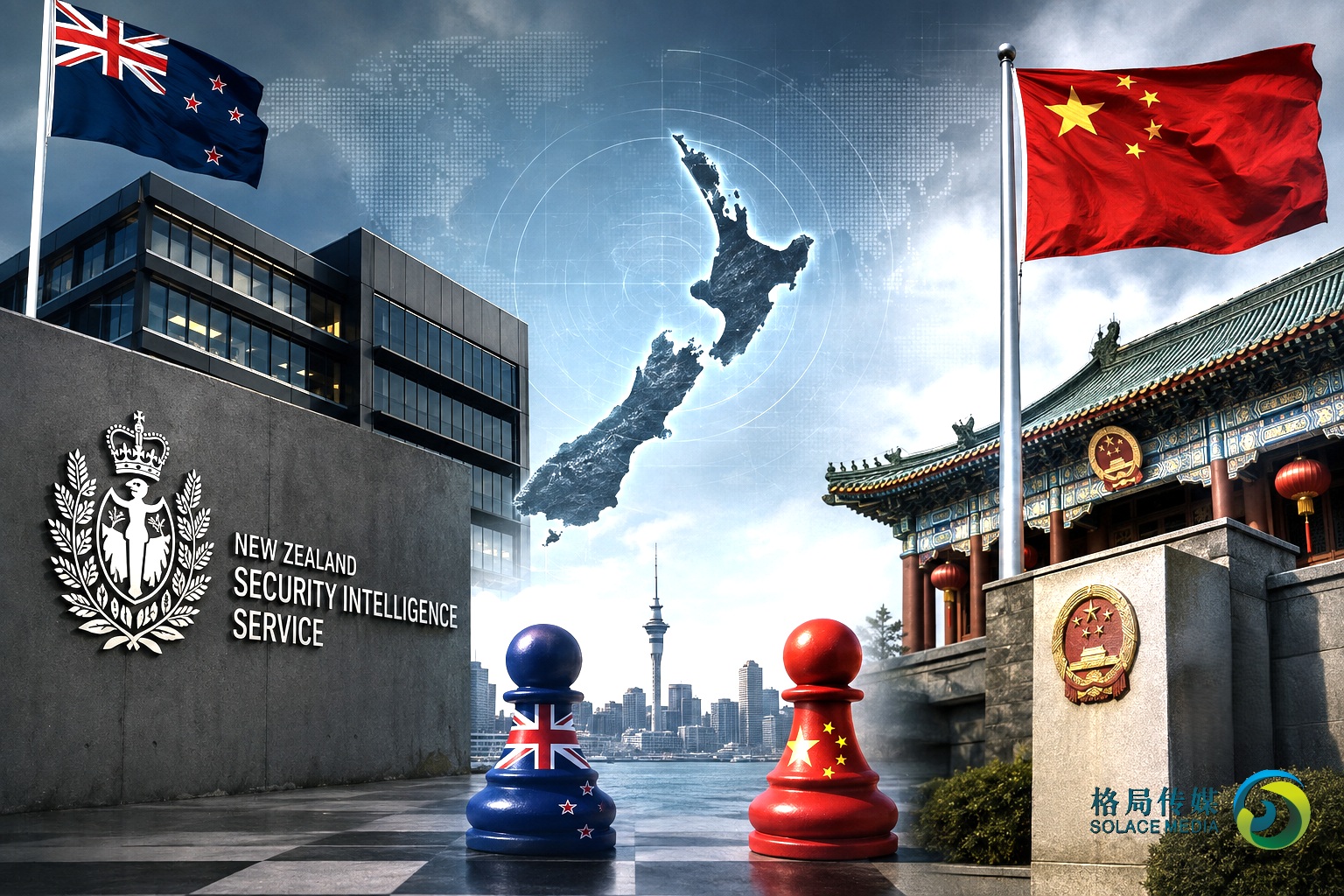

【格局新闻网专讯】The New Zealand Security Intelligence Service (NZSIS) has released its latest New Zealand’s Security Threat Environment report, providing a comprehensive assessment of foreign intelligence activities and foreign interference facing the country. The report states that New Zealand’s security environment is currently in its most challenging period in recent years, explicitly naming China as the only state carrying out espionage in New Zealand “at scale.”
In response to the intelligence agency’s assessment, the Spokesperson for the Chinese Embassy in New Zealand issued a statement strongly rejecting and condemning the allegations. The Embassy pointed out that the report is steeped in a Cold War mentality, describing the claims as baseless and fabricated out of thin air, while warning relevant forces against damaging the hard-won mutually beneficial outcomes between the two nations.
Andrew Hampton, Director-General of Security at NZSIS, stated in the report that malign threat activities detected over the past 12 months have shown a deteriorating trend. The report noted that while several states conduct intelligence gathering in New Zealand, China stands in a category of its own regarding the “scale” of its espionage, and remains the most active country conducting foreign interference.
Regarding specific case studies, the intelligence agency cited an attempt by China’s Purple Mountain Observatory to install ground-based space infrastructure (GBSI) in New Zealand. The NZSIS assessed that the facility possessed the capability to collect intelligence of military value and that the local business involved was likely unaware of this capacity. The agency stated it successfully disrupted the project’s implementation. Furthermore, the report alleged that Chinese military intelligence services have increased their targeting of professional networking sites and online job platforms to directly target current and former New Zealand government officials with access to classified or sensitive information, seeking non-public military, political, and economic intelligence.
On the front of foreign interference, the NZSIS categorized activities into “political interference,” which targets democratic processes, and “societal interference,” which affects community groups and protest movements. The report emphasized that while China is the most active actor in these domains, the duty of the NZSIS is to protect local minority communities from foreign government coercion. Despite the severe warnings, Hampton added that this should not prevent New Zealand businesses from engaging or doing business with Chinese entities, emphasizing that commercial sectors should maintain an “eyes wide open” approach when expanding internationally.
Addressing the NZSIS threat assessment, the Spokesperson for the Chinese Embassy in New Zealand expressed firm opposition and strong dissatisfaction. The Chinese side stated that the New Zealand report once again hypes up the so-called “China interference” and “China threat” narratives, noting that the allegations either stigmatize normal academic exchanges, civil engagements, and practical cooperation as espionage, or are entirely fabricated.
The Chinese Embassy Spokesperson stressed that the essence of China-New Zealand cooperation is mutual benefit and win-win outcomes. Through joint efforts, bilateral relations have achieved steady progress in recent years, serving the fundamental interests of both peoples. The statement noted that hyping up the “China threat” serves specific geopolitical agendas and the narrow political interests of certain forces, which are bound to fail. The Embassy urged relevant forces not to undermine mutually beneficial relations for selfish gains, warning that serving as a pawn for international anti-China forces will ultimately backfire.
The Embassy reaffirmed that China places great importance on its relationship with New Zealand and remains willing to work on the basis of consensus reached by leaders of both countries to enhance political trust, practical cooperation, and cultural exchanges. As the global geopolitical landscape continues to evolve, striking a balance between national defense security and economic partnership remains a central topic of ongoing focus for the New Zealand government and both societies.